If Ever, Oh Ever a Wiz There Was?
Elizabeth Moll
Personal Response to Film:
The Wizard of Oz
film is a timeless classic that has brought the world of fantasy to viewers for
more than seventy years. It’s been credited
for its’ masterful Technicolor use, its’ timeless musical adventure, and for
me, its’ ability to scare me straight under my blankets. Objectively, the film
is a not short of masterpiece. Plain and
simple. It takes the viewers on a magical journey to ‘The Land of Oz’, while
explicitly teaching themes about good and evil, finding the true potential in
yourself and, of course, realizing there’s no place like home. That’s good and
all, but has no real standing with a 6-year-old.
Watching it again
for the first time as an adult, it wasn’t much better. It still worried me and
I was worried that my childhood nightmares would resurface. Luckily they
didn’t. I was, however, able to glean the brilliant qualities from re-watching
it as an adult. Like many critics claim, the 1939 film is an astonishing
cinematic success of its’ time. The director took an already great story and
complimented it with brilliant cinematic elements. It also bears the qualities
of an impressive musical. Many even say it’s a thoughtful tale filled with
allegoric characters, figures and events. I’m not convinced that the author of
the book, L. Frank Baum was the wonderful wizard people think he was, but there
was definitely more going on in his book and this film, than meets the eye.
Summary of Critical Article:
Title: “The Wizard of Oz: Parable on Populism”
Author: Henry M. Littlefield
Henry
Littlefield’s historical point of view in his article derives from a thorough
look at the life of The Wonderful Wizard
of Oz author, L. Frank Baum. Although not a biography of Baum, Littlefield
does describe many aspects of Baum’s world in order to support ideas in his
article, “The Wizard of Oz: Parable on Populism”. Littlefield depicts Baum as a
small town, prairie life man from South Dakota. South Dakota at the time, was
filled with western farmers that were preparing for a revolt in what became
known as the Populist Party. Littlefield (1964) writes, “The populist movement
symbolized a desperate attempt to use the power of the ballot” (p. 49). He goes on to write how the populist party
became a cornerstone for allegory in Baum’s book. Characters like the Tin man
(once a woodsman), who was worked tirelessly into a machine, and the Scarecrow
thought of as a ‘straw-headed’ man whose actually quite capable, represent the
populist view. Littlefield also proposes other allegories in Baum’s book: The
Lion literally being politician William Jennings Bryan, Emerald City being the
nation’s capital, and even the flying monkeys being the plains Indians. These
various allegories imply that Baum used his book as a way to make note of the
upheaval in America at the time. Littlefield’s article paralleled the
similarities found between Baum’s book and America during a time when big
changes were to come, and the wizard of writing held all the hidden secrets.
Response to Critical Article:

Henry Littlefield
wrote a solid article revealing the allegory within L. Frank Baum’s’ The Wonderful Wizard of Oz. The article related
the book much to the Populist Party of the late 1930’s. Although there were
many interesting concepts explored, Littlefield summed it up best for me when
he writes, “It is an indigenous creation, curiously warm and touching, although
no one really knows why” (1964, p. 47). Whole-heartedly, I have no clue to why
this film has been such a timeless sensation. I don’t particularly enjoy the
movie, as I’ve earlier expressed. However, I do know that the film has a way of
helping you escape reality, then have you praying for Dorothy’s safe arrival
back home to Auntie Em. So for me, Littlefield just about perfected my views in
that one sentence.
The basis of
Littlefield’s article explores the idea that Baum’s story was a direct
resemblance of the populist movement. I have a hard time allowing myself to
believe that there is an allegoric explanation to just about everything in the
story. With all the different interpretations out there, the credibility of
Littlefield’s viewpoints become less and less. The article provides a blanket
explanation from a historical standpoint, which provides much to be appreciated.
It definitely raises some questions about Baum’s intentions when he wrote this.
That being said, part of writing is imagination. And just because some parts
seem comparable to America and the populist viewpoint, doesn’t mean that Baum
created an imaginary world consciously interpreting those. It would be
interesting to see how Littlefield views the movie in comparison to the book.
I did really like
how Littlefield expressed some important themes. Themes in stories, likened to
historical events, are more telling and valuable. It’s easier to see how Baum
may have used these in his book rather than an entire story filled with
allegory. The one that stuck out to me the most was the silver shoes.
Littlefield (1964, p. 55) writes, “While goodness affords a people ultimate
protection against evil, ignorance of their capabilities allows evil to impose
itself upon them.” The silver shoes provided protection for Dorothy, but her
ignorance of her own ability to get home allowed the evil to impose itself.
This type of life lesson bridges the book and the late 1930’s America in a much
more convincing way.
Consideration of Critic’s Use of
Critical frameworks/concepts:
It was immediately
obvious that Henry Littlefield took a historical approach in his critical
article. He spent a long time describing
L. Frank Baum’s life and the events of America around the time Baum wrote the
story. It’s clear that he related the work to the populist movement of the late
1930’s. Littlefield even went as far as suggesting that characters from the
story are direct representations of political figures.
Film Analysis:
The director and
crew of The Wizard of Oz have a lot to be praised for. The film is filled with
unique storytelling film elements that enhance an already picturesque concept.
One of the scenes I really enjoyed was the poppy field scene when the
characters (Dorothy, the Tinman, the Scarecrow and the Lion) see Oz from a substantial
point of view. The scene starts with an establishing shot of the field
exhibiting the striking Technicolor in full bloom leading right up to the point
we are reintroduced to the characters. The next shot we see is a straight cut
to behind the characters. It became one of the more memorable shots because the
view has full sight of the characters, the poppy field and Oz all in one. Then
a series of straight cuts to medium and close-up shots give full expression of
the characters’ excitement to be so close to Oz that you are feeling the
anticipation with them. This elation continues as the camera moves with the running
characters during a tracking shot. The viewer again gets a straight cut to a
subjective view of Oz. The moment is so powerful that it makes the next part of
the scene chilling even though the environment feels anything but. You know
right away something is wrong when the camera moves right into a close-up of a
distressed and tired Dorothy. Then as she calls for Toto, you get a straight
cut to see him lying on the ground. At this point the camera back up to a
medium and then a long shot of the characters, likely to show that their cries
for help are answered with nothing more than an open field. That is, until a
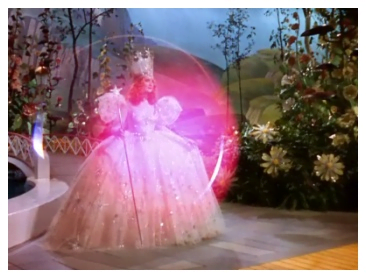
lap dissolve of Glinda appears of her waving her magical wand. The viewer gets
to have an objective view of both the characters and their troubles and then of
Glinda rescuing them. This scene is crammed with purposeful film elements that
perfectly move the storyline along, all while getting to see the magical
Technicolor dream world.
References:
Littlefield, H. M. (1964). The Wizard of Oz: Parable on Populism. American
Quarterly, 16(1), 47.

No comments:
Post a Comment