Title: The
close-up of close-ups and other great features of Once Upon a Time in the West
Name: Elizabeth
Moll
Personal Response to
Film:
Since I
am forwardly a helpless romantic, no one would presume that my kryptonite is
for Western-like movies. Although I’m
not usually captivated by Westerns that are tilted more toward traditional
standards, I was quickly charmed by Once
Upon a Time in the West’s main character, Harmonica, and the films’ rich
plot. For me, Once Upon a Time in the West hit all the fundamental criteria for a
‘Great’ film. It has an abundance of strong characters and symbols that
enriched the films meaning. Furthermore, despite it’s slow moving storyline,
typical for Western’s, it keeps the audience on their feet. We remain unsure of
who exactly we’re rooting for and in the end actually feel sorry for characters
that we despised at the beginning. Yes, I’m talking about poor Cheyenne. There
is much to appreciate about this film, and a few of the characteristics really
set it apart from classic Westerns and brought it parallel to my adoration of
films like Hatfields and McCoys and Lawless.
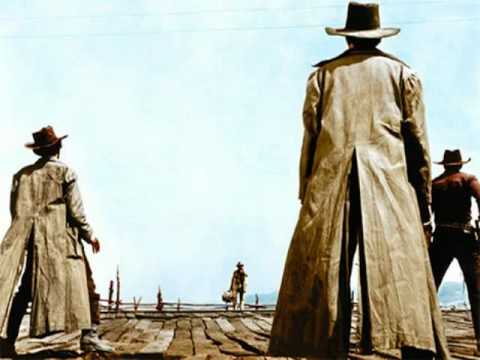 This film’s lack of dialogue
is a critical point of view. More information is revealed between the words
rather than the words themselves. This indicates that the film’s director,
Sergio Leone, fantastically used the almost three-hour movie in a way that makes
the audience pay more attention to what’s being done, rather than what’s being
said. Considering that Westerns were a popular choice for silent films, I’m not
all that surprised. However, I’ve had my fair share of watching Westerns and Once Upon a Time in the West tops most.
This film’s lack of dialogue
is a critical point of view. More information is revealed between the words
rather than the words themselves. This indicates that the film’s director,
Sergio Leone, fantastically used the almost three-hour movie in a way that makes
the audience pay more attention to what’s being done, rather than what’s being
said. Considering that Westerns were a popular choice for silent films, I’m not
all that surprised. However, I’ve had my fair share of watching Westerns and Once Upon a Time in the West tops most.
Another
aspect I feel added boundless value to the film and put it on the radar of
‘greatness’ is the characterization. Everyone from Sam to the barman to Frank
and Jill, we’re spot on characters. There are well-developed round characters
like Frank, Jill, Cheyenne, and Harmonica that are the core of the story. Then
you have sub-important characters that add to the story, but are pretty much
static. Then you have all the others that are briefly shown; they die in an
exciting gun battle, like Cheyenne and Franks’ men, who are flat characters that
never say anything, but it doesn’t matter because they move the story along.
It’s

Leone
directed this film that was pieced together flawlessly. For enjoyment it had a
loaded plot, gunfights and a handsome lone wolf type character to avenge his
brother’s death all while connecting the pieces to initiate the building of a
new American town. From a critical perspective the reflection could go on and
on. The trains, horses, guns and desert land make it a classic western. But the
film also has numerous symbols that help create a double meaning that lines the
story’s main plot. This film is one for the hearts and minds of Americans that
will transcend time. Within Sweetwater lies the future of America, and like any
great Western film, it was built upon the sweat and death of the good and bad
guys.
Summary of Critical
Article:

John
Fawell extensively analyzed director Sergio Leones’ use of close-ups in the
film Once Upon a Time in the West. Fawell’s
investigation into what many would consider an extensive use of close-ups gives
a detailed interpretation of the impressive thoughtfulness behind Leone’s
iconic film style. Pulling from a vast list of resourceful references, Fawell
delves into this seemingly transparent topic by noting that despite being
infamous, Leone’s close-ups are less than cherished by some. However, within
those who can value this type of work, are individuals able to capture an
entire story beyond the dialogue. According to Fawell (2005), Leone was
particularly fascinated by eyes, saying that they “revealed ‘everything you
need to know about the character … courage, fear, uncertainty, death’” (p.
139). Fawell strengthens this comment by later writing that “the implicit
meaning of the words, and the most explicit meaning of the scene, is to be read
in the two characters’ eyes.” (2005, p. 140). Additional exploration reveals
that Leone uses close-ups as a benchmark for the types of actors he uses (or as
Leone calls models). Leone tends to choose actors based upon their facial
features rather than their ability to act (Fawell, 2005). Fawell uses the
character Harmonica as an example of truly defining facial features. Bronson,
who plays Harmonica in the film, has adoring facial features for this type of
work with “its deep grooves and crevices” (Fawell, 2005, p. 143). This same idea is extended to many other
characters including Jill, Cheyenne, and Frank. Not only are they actor that
can bring this additional meaning to the film, but they also have defining
close-up that are particular to their character. Fawell goes on to consider not
only what it’s like for Leone to choose actors, but also how actors react to
this particular film style that Leone portrays in films like this one. This
technique seems unattractive to actors that are unable to trust the camera, but
who are also unable to let go as Leone directs (Fawell, 2005). Letting go, is a
clear requirement for Leone as he “aim[s] to strip away imitative habits. He
approached actors as he did the other aspects of his Western, as a restorer,
returning them to their true quality.” (Fawell, 2005, p. 147). Fawell credits
Leone with the ability to use his close-ups as a narrator for Once Upon a Time in the West, specifically
praising him for the powerful way he uses the subtle features of not only
actors, but of objects in a way that enchants the audience.
Response to Critical
Article:
Fawell’s
close-up of the close-ups was an inspiring journey through the films obvious
use of details. It was clear that the close-ups were many and that they had the
ability to story tell, but I failed to see how important it was from the director’s
perspective. My first time viewing of a film is always for pure enjoyment. What
did I like and hate about what I’ve seen? One thing I adored about this film
was the quietness, particularly the way it was used in telling the story. I attribute
this to Leone’s keen sense of particulars, but I lacked in understanding what
exactly this meant to the director. Fawell wrote an exceptional review of this,
from many angles. As I was reading through the first part of his chapter about
why Leone does close-ups and how the characters had their own genre of
close-ups, I started to ask myself what about the actor’s point of view? Are
they credited for their part of the close-ups? Then right away Fawell went on
to write how “the job of the director was to get past the actor’s accumulation
of technique and to strike into this virgin territory” (Fawell, 2005, p. 147). It’s
amazing how hard it is to just be. This, meaning that many actors need to
unlearn what they have become accustomed to. Fawell quotes Leone saying that “The
less you do in this film, the more you’ll benefit.” (2005, p. 146). I wish
there was more for me to respond to, but I feel that Fawell hit all the major
and minor aspects of close-ups giving a splendor of recognition to Leone’s
brilliant directing.
Consideration of
Critic’s Use of Critical Frameworks/concepts:
In his chapter of close-ups,
Fawell was very accustomed to reviewing the film with a formalist eye. He critiqued
the films use of close-ups through the patterns and meaning to the overall
theme. He also took a lot of time researching Leone’s work in other movies,
with actors in other movies and with different actors and film makers. That
being said leads me to believe that there is a bit of historical approach to
this analysis as well. Either way, the combination molded into a well-developed
interpretation of Once Upon a Time in the
West’s use of close-ups.
Film Analysis:
Sergio Leone was thoughtful
when considering how to make a Western film look and feel like a real Western.
There was a particular scene at the beginning of the movie that shouted Western
and embraced a clear perspective that has the audience on edge. This is the bar
scene where Harmonica is reintroduced. Cheyenne enters the bar just after
escaping from the law.
Staring
from when Cheyenne first takes a drink, the audience is quickly given more
information about what happed leading up to this point. Cheyenne takes a swig and
his hands are still in cuffs. Now the audience knows that this person is an
outlaw. The information sets up the tone for the scene. Simultaneously, the
harmonica is playing which is an eerie (sometimes annoying) sound that becomes
iconic throughout the film for introducing Harmonica’s presence, even when he’s
not actually playing. Then Leone meticulously shoots back to back close up,
head shots of certain characters. Again this is classic film shooting for Westerns,
but emits a particular mood that is carried through the scene accompanied by
the harmonica sound. The next shot is an over-the-shoulder moving shot giving
an up close perspective. This shows where Cheyenne is going, but at the same
time leaves the audience in an unnerving state. It’s important to note how dark
the set is during this time. The low-key lightening is limited. During the
moving shot, a glimpse of a lantern is shown and a window that is covered by
tarp material. Again, adding to the ongoing sinister type feeling. Cheyenne
stops and a straight cut moves the shot to his face, flushed to the left while
the lantern is now also shown to the right of him. His particular facial
movements and the next series of shots preempts the audience for what his next
move is. Cheyenne pushes the light towards Harmonica and at the same time added
background music booms as we are reintroduced. In an ever so brilliant way,
Leone uses the light and opposing shadow from the lantern to light and shade
Harmonica’s eyes during a close-up of his face, closing in on the mysterious
Harmonica.
References:
Fawell, J. W. (2005). The art of Sergio Leone's Once upon
a time in the West: A critical appreciation.
Jefferson,
NC: McFarland.

No comments:
Post a Comment